Union County Epoxy Flooring | Epoxy Garage Floors, Polyaspartic & Concrete Floor Coatings
Garage, basement, patio and shop floors coated in Indian Trail, Waxhaw, Monroe, Weddington, Stallings and Wesley Chapel.
Union County Epoxy Flooring coats garage, basement, patio and shop floors with epoxy, polyaspartic and flake systems. Most calls start with one of three problems: a bare slab that dusts and stains, a do-it-yourself kit that is peeling at the garage door, or a new house whose floor never got finished.
Coating concrete is like putting a sticker on a dusty window: it looks fine until the first corner lifts. So the day is mostly prep. We grind the slab to open the pores, test it for moisture, fill the cracks and joints, and only then roll the color. In our opinion the topcoat is the cheap part of a floor and the grinding is the part worth paying for, so a quote names both.
- Diamond-ground prep on every floor, never acid etching
- Polyaspartic topcoats that cure in hours
- Slabs moisture-tested before any coating goes down
- Flake and color samples brought to your garage
- A written quote naming the system, thickness and square footage
Residential epoxy and garage floor coatings
Swatch colors are sample blends, not the renter's work.
Epoxy garage floor coatings
A 100 percent solids epoxy is the base of most garage floors we coat. The slab is diamond-ground to a CSP 2 to 3 profile, cracks and joints are filled, and the epoxy goes down at roughly 10 to 20 mils with flake or a solid color on top. Coated well, it lasts 10 to 20 years. Coated badly, it peels at the garage door in two summers, which is why most of the day is prep.
Polyaspartic floor coatings
Polyaspartic is a UV-stable polyurea topcoat that cures in hours instead of a day. Over a ground slab it resists hot-tire pickup and sun yellowing better than a plain epoxy topcoat, and some systems are drive-on the next day. It costs more per square foot. In our opinion it is the right topcoat for any garage that gets sun through the door.
Flake and chip floor systems
Full-broadcast vinyl flake in 1/4 inch or 1/8 inch blends, locked under a clear topcoat. The flake hides pits, hairline cracks and tire marks and gives wet shoes some grip. Pick a blend from samples laid on your own slab, because a color chip under showroom lights lies.
Metallic epoxy floors
Pearlescent pigments worked through clear epoxy into marble, lava and river effects. Metallic suits basements, man caves and showrooms more than a working garage, because the gloss shows every scratch. Each floor is one-off, so we pour a sample board before the real thing.
Basement floor coatings
Basement slabs push moisture up through the concrete, and a coating over wet concrete blisters. We test with calcium chloride or in-situ relative humidity probes before choosing a primer, and use a moisture-vapor barrier primer when the reading is high. Finished basements get a low-odor system.
Concrete floor sealing and resurfacing
Pitted, spalled or scarred slabs need repair before color. Self-leveling overlays and polymer patches fill the low spots, and a clear sealer protects bare concrete in a workshop that does not need a full coating.
Quartz epoxy floors
Double-broadcast colored quartz in epoxy gives a hard, slip-resistant, textured floor for laundry rooms, mudrooms, pool houses and workshops. It is thicker and more forgiving of imperfect concrete than a smooth coat, and it wears like river gravel.
Patio and pool deck coatings
Outdoors the topcoat does the work: a UV-stable polyaspartic with a cool-touch additive and a slip-resistant texture for wet feet. Patios, porches, pool decks and walkways are ground, patched and sealed against moisture from below.
Epoxy floor repair and recoating
Hot-tire pickup, peeling kits from the big box store and delamination all start the same way: weak prep. We grind off the failed coating, repair the slab and recoat. A floor that peeled once will peel again if the old coating is only scuffed.
Specialty coating services
Concrete grinding and surface prep
Diamond grinders open the slab to a CSP 2 to 3 profile, with dust-controlled vacuums so the house stays clean. Acid etching is not a substitute.
Moisture mitigation primers
Calcium chloride and relative humidity readings decide whether the slab needs a vapor barrier primer before any color goes down.
Crack and joint repair
Hairline cracks are routed and filled, and control joints get a flexible polyurea fill so they move without telegraphing through the coating.
Slip-resistant and ADA textures
Aluminum oxide or quartz in the topcoat adds grip for wet shoes, ramps and entries, graded to the surface rather than guessed.
Cove base and wall coatings
A 4 to 6 inch coated cove turns the floor up the wall, which seals the edge and makes shop and kitchen floors washable.
Color, flake and custom logo design
Flake blends, solid colors, stripes and logo inlays are laid out on a sample board first, so the choice is made before the first pour.
Commercial and industrial floor coatings in Union County
Warehouses and distribution
Forklift and pallet-jack traffic needs a thick, abrasion-resistant system and a pre-planned phasing schedule so bays stay open.
Auto shops and dealerships
Chemical-resistant floors that shrug off brake fluid and hot tires, in light colors that make a service bay look bigger.
Retail and showrooms
Metallic and polished-look floors for stores and showrooms, installed in off-hours so the doors open on time.
Restaurants and commercial kitchens
Joint-free coated floors with a coved base that wash down clean and meet health-inspection expectations.
Medical, labs and clean rooms
Joint-free, low-odor, easy-to-sanitize systems with no grout lines for bacteria to settle in.
Breweries and food processing
Chemical- and thermal-shock-resistant coatings built for hot washdowns, spilled wort and constant drainage.
How much does an epoxy garage floor cost in Union County?
Price follows square footage, the system and how much repair the slab needs. A typical two-car garage is about 480 square feet and a three-car about 720. Every quote is itemized, with the system, the thickness and the prep named.
| System | Installed, per square foot | Two-car garage | Three-car garage |
|---|---|---|---|
| Solid-color epoxy | $3 to $6 | $1,440 to $2,880 | $2,160 to $4,320 |
| Flake epoxy with polyaspartic topcoat | $5 to $9 | $2,400 to $4,320 | $3,600 to $6,480 |
| Metallic epoxy | Quoted by sample board | Quoted | Quoted |
Typical Charlotte-area residential ranges. Your written quote replaces them. Cracks, spalling and old coating to remove add to the prep line.
Why Union County slabs need prep before color
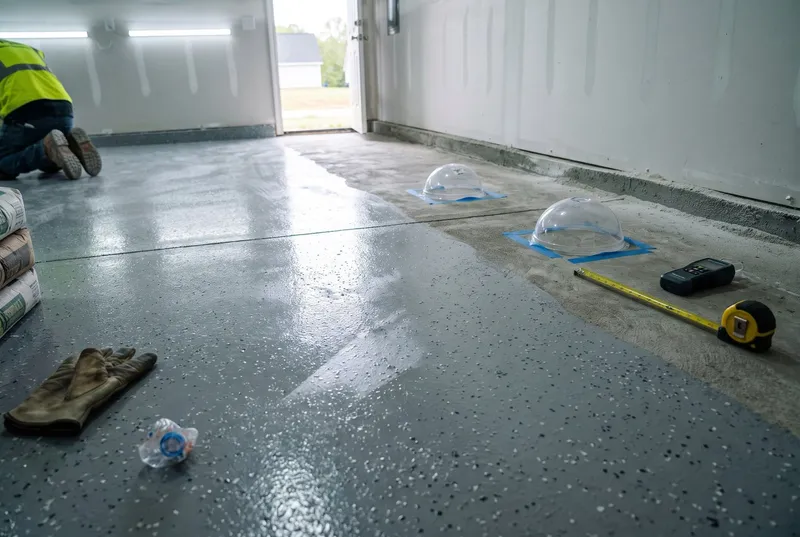
Slabs here sit on red Piedmont clay that holds water, and moisture vapor rising through the concrete is the usual reason a coating blisters. New construction adds a second variable: a garage poured last month is still giving off water, and coating makers commonly want a slab cured about 28 days first.
Summer adds heat. A garage floor in July can get hot enough to soften a weak coating, which shows up as tire marks, called hot-tire pickup. In our opinion a coating that fails is almost always a moisture or prep failure, not a product failure.
That is why the first visit includes a moisture test and a look at the slab, not just a color chart.
How we coat a floor: six steps
Walk the slab and test moisture
We look at cracks, old coating and drainage, and take calcium chloride or humidity readings. The result decides the primer.
Diamond-grind the surface
Grinders cut the slab to a CSP 2 to 3 profile and remove laitance or old coating. Dust goes into a vacuum, not your driveway.
Repair cracks and joints
Cracks are routed and filled, spalls patched and joints sealed, then the repairs are ground flush.
Prime
A penetrating primer, or a moisture-vapor barrier where the readings call for one, locks the repairs and the slab together.
Base coat and flake broadcast
Pigmented epoxy goes down and the flake is thrown in by hand to rejection, then scraped and vacuumed once cured.
Topcoat and cure
A clear polyaspartic or epoxy topcoat seals the floor. We walk it with you and leave the cure schedule in writing.
When can you use the floor?
Most competitors skip this, and it is the question people ask first. Times below are typical for each system; the data sheet for the coating on your floor sets the exact figures.
| System | Walk on it | Park a car | Full cure |
|---|---|---|---|
| Solid-color epoxy | Next day | 2 to 3 days | About 7 days |
| Flake epoxy, polyaspartic topcoat | 4 to 8 hours | 24 hours | About 3 to 7 days |
| Metallic epoxy | Next day | 3 days | About 7 days |
| Patio or pool deck polyaspartic | 4 to 8 hours | Not applicable | About 3 days |
Epoxy or polyaspartic: which lasts longer?
They do different jobs. Epoxy builds thickness and bonds to the concrete; polyaspartic is the hard, clear topcoat over it. Most of our flake floors use both.
| Epoxy | Polyaspartic | |
|---|---|---|
| Installed cost | Lower, about $3 to $6 per square foot in solid color | Higher, about $5 to $9 per square foot with flake |
| Cure time | Walk on it next day, park in 2 to 3 days | Walk on it in hours, park in about a day |
| Sun and UV | Can amber in direct sun | UV stable, stays clear |
| Job it does | Builds thickness and bonds to the slab | Hard, clear wear surface over the epoxy |
| Best for | Shaded garages, basements, budget jobs | Garages with sun, patios, fast turnaround |
Serving Union County and surrounding areas
One crew covers the county, from the newer subdivisions of Indian Trail and Stallings to the older garages and farm shops outside Monroe and Waxhaw.
- Indian Trail
- Waxhaw
- Monroe
- Weddington
- Stallings
- Wesley Chapel
Epoxy flooring FAQ
Epoxy or polyaspartic: which lasts longer?
Polyaspartic holds up longer in sun and heat, and a good epoxy base under it is what bonds to the slab. Most flake floors use both.
How long before I can park on the floor?
Under a polyaspartic topcoat, about 24 hours. A plain epoxy floor usually needs 2 to 3 days. We leave the exact schedule in writing.
Will the coating peel from hot tires?
A well-prepped, well-cured floor does not. Hot-tire pickup comes from a poorly ground slab or a coating applied before the concrete was dry.
What does a two-car garage floor cost?
Roughly $1,440 to $2,880 for solid-color epoxy and $2,400 to $4,320 for flake with a polyaspartic topcoat, before repair. Your written quote replaces these ranges.
Can you coat a floor that was coated by a kit before?
Yes, but the old coating has to be ground off. Coating over a peeling kit just peels again.
Do you coat basements and patios?
Yes. Basements get a moisture test and a vapor-barrier primer if the reading calls for it. Patios and pool decks get a UV-stable, slip-resistant topcoat.
How do you handle moisture in the slab?
We test with calcium chloride or in-situ humidity probes before choosing a primer, and use a moisture-vapor barrier when the reading is high.
Does the floor get slippery when wet?
Flake and quartz add texture by themselves. For wet areas we add an aluminum oxide grit to the topcoat and tell you what it is.
How long does the coating last?
A well-prepped epoxy system lasts 10 to 20 years in a home garage. Heavy commercial traffic shortens that.
Do I have to empty the garage?
Yes. The floor has to be clear wall to wall for grinding. Plan on one to two days.
Can you coat a brand-new slab?
Yes, after it has cured. Coating makers commonly want about 28 days, and we test moisture before we start.
Which towns do you serve?
Indian Trail, Waxhaw, Monroe, Weddington, Stallings and Wesley Chapel, plus the rest of Union County.
Ready to see your garage in color?
Free in-garage quote. Samples come to your door.